Quick answer
Quick answer: An exchange fund pools appreciated stock contributed by multiple investors and gives each investor a partnership interest in a more diversified portfolio. A properly structured contribution may be tax-deferred rather than immediately taxable, but the investor accepts illiquidity, fund fees, partnership rules, and the risk of receiving a portfolio that still may not fit the final plan. No single strategy is best for every concentrated-stock holder.
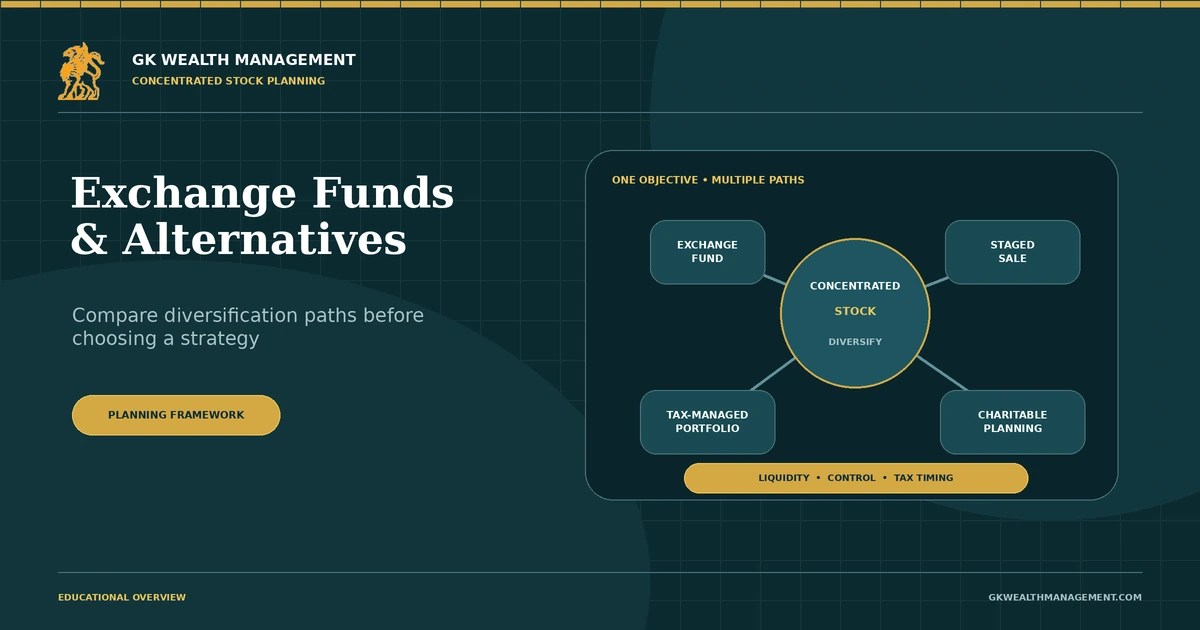
A large low-basis stock position creates a real tension. Selling reduces company-specific risk but recognizes gain. Holding postpones the tax while leaving the household exposed to one company.
Exchange funds are one possible answer. They are not the only answer, and they should not be evaluated on the contribution-day tax result alone.
What is an exchange fund?
An exchange fund is generally organized as a partnership. Investors contribute different appreciated stocks and receive interests in the pooled partnership. Instead of owning one company directly, an investor owns an interest in a fund holding many contributed positions and other assets.
The goal is diversification without an immediate sale of the contributed stock. That is tax deferral, not tax elimination. The investor generally carries economic and tax attributes into the partnership interest, and later distributions or sales can bring the embedded gain back into view.
How IRC §721 applies
Internal Revenue Code §721 generally provides nonrecognition when property is contributed to a partnership in exchange for a partnership interest. Section 721(b), however, removes that treatment when the partnership would be treated as an investment company if incorporated.[1]
Exchange funds are designed around that exception. The structure, asset mix, timing, contributor mix, and fund documents all matter. An investor should obtain tax advice on the actual fund rather than relying on a general description of §721.
Why exchange funds may hold non-securities assets
Exchange funds often hold a meaningful allocation to assets that are not readily marketable securities. Direct real estate is common. The relevant framework is not a simple statutory command that every fund hold exactly 20% real estate; it concerns investment-company treatment and the character of the fund's assets.
That allocation can change the portfolio's liquidity, valuation, expenses, income, and risk. An investor seeking stock diversification may end up accepting real-estate or other private-asset exposure that deserves separate due diligence.
Why seven years comes up so often
The familiar seven-year period is tied to partnership anti-mixing rules, including IRC §§704(c)(1)(B) and 737. Certain distributions of contributed property to another partner, or distributions of other property to the contributing partner, can trigger pre-contribution gain when they occur within seven years.[2]
That is not the same as a universal law saying every investor must remain in every exchange fund for seven years. Fund agreements typically build restrictions around the tax rules, and early-exit rights vary. The practical result is often a long, illiquid commitment.
What can go wrong with an exchange fund?
The fund can underperform, carry concentrated sector exposures, own unwanted securities, incur meaningful management and operating expenses, or hold private assets that are difficult to value. A diversified basket also does not guarantee protection from a broad market decline.
Investors may have limited control over security selection and distributions. A later in-kind distribution may deliver a basket that still requires a taxable transition. Sponsor quality, borrowing, valuation policy, redemption terms, tax reporting, and conflicts all deserve review.
Alternative 1: a staged sale
A staged sale divides the concentrated position into planned sales across tax years or decision points. The investor recognizes gain, but gains may be coordinated with capital losses, charitable gifts, changing income, estimated taxes, and the household's risk limit.
The advantage is clarity and liquidity. The disadvantage is continued exposure while the schedule runs. A written rule, such as maximum position size or fixed sale dates, can reduce the temptation to abandon the plan after price moves.
Alternative 2: a tax-managed portfolio
A long-only direct-indexing portfolio or a long/short tax-managed separately managed account may realize capital losses that offset gains from selling concentrated stock. Losses are not guaranteed, and wash-sale, short-sale, straddle, and capital-loss rules can limit their value.[3]
This approach can offer more control and daily liquidity than a private exchange fund, but long/short versions add margin, borrow, tracking-error, and forced-liquidation risk. Fees and financing costs should be compared with the expected after-tax benefit.
Alternative 3: collars and prepaid variable forwards
A collar uses options to place a floor under some downside while giving up some upside. A prepaid variable forward may provide liquidity today in exchange for delivering a variable number of shares or cash later. These arrangements can be useful, but terms matter.
IRC §1259 can treat certain hedges as constructive sales of appreciated positions. IRS Revenue Ruling 2003-7 found no current sale on one specific prepaid variable-forward fact pattern, not every transaction.[4] Securities and tax counsel should review the agreement before execution.
Alternative 4: charitable giving
An outright gift of appreciated stock to a qualified charity or donor-advised fund can remove shares from the portfolio while supporting charitable goals. The investor gives up the asset permanently, so the strategy should begin with charitable intent rather than taxes.
A charitable remainder unitrust, or CRUT, is more complex. The trust may sell contributed appreciated stock without immediate trust-level capital gains tax, but distributions to noncharitable beneficiaries follow statutory tax-ordering rules. A CRUT is not a tax-free personal investment account.[5]
Compare liquidity, control, tax timing, and risk
| Approach | Liquidity and control | Tax point | Main tradeoff |
|---|---|---|---|
| Exchange fund | Usually limited for years | Contribution may qualify for nonrecognition | Illiquidity, fund terms, fees, future distributions |
| Staged sale | High control | Gain recognized as shares are sold | Tax paid sooner; concentration declines predictably |
| Tax-managed SMA | Generally daily liquidity | Losses may offset realized gains | No guaranteed losses; manager and strategy risk |
| Collar or PVF | Contract-dependent | Constructive-sale review required | Complexity, counterparty risk, limited upside |
| Charitable strategy | Assets committed to charity or trust | Depends on vehicle and distributions | Irrevocability and charitable-purpose requirements |
A decision framework for concentrated stock
Start with the maximum single-stock exposure the household can tolerate and the deadline for getting there. Then compare the tax cost, fees, liquidity, control, credit risk, charitable intent, and operational burden of each route.
- How much of net worth, future income, and career risk depends on the same company?
- How quickly must concentration decline?
- What tax would an immediate or staged sale create?
- Will the investor need access to the capital during the proposed holding period?
- What securities or private assets could be received later?
- Who is responsible for the tax opinion, legal documents, valuation, custody, and ongoing reporting?
Frequently asked questions
What is an exchange fund for concentrated stock?
An exchange fund is generally a partnership that accepts appreciated stock from multiple investors in exchange for partnership interests. If structured properly, IRC §721 may permit nonrecognition at contribution, subject to the investment-company exception.
Is the seven-year exchange-fund lockup required by law?
Not exactly. Seven years is important because partnership rules can trigger gain on certain distributions within that period. The actual lockup and redemption terms come from the fund documents.
Does an exchange fund have to hold 20% real estate?
No rule simply says every exchange fund must hold 20% real estate. Funds often use direct real estate or other non-readily marketable assets as part of avoiding investment-company treatment, but the structure must be reviewed as a whole.
Are prepaid variable forwards tax-free?
No. IRS guidance reached a favorable no-current-sale result for a specific structure. Other terms may trigger constructive-sale or related tax rules, so tax and securities counsel should review the transaction.
Does a CRUT eliminate capital gains tax?
A CRUT may sell appreciated assets without immediate trust-level capital gains tax, but beneficiary payments are taxable under ordering rules. The arrangement is charitable and irrevocable, not a tax-free personal account.
Put the decision in the context of your full plan
GK Wealth Management can compare an exchange fund with staged sales, tax-managed portfolios, hedging, and charitable strategies, then coordinate the chosen approach with the client's CPA and attorney.
Schedule a conversation with GK Wealth Management.
Disclosure
This material is for educational purposes only and is not personalized investment, tax, or legal advice. Exchange funds, private partnerships, derivatives, short selling, and charitable trusts involve investment, liquidity, tax, legal, valuation, and counterparty risks. Tax deferral is not tax elimination, and no strategy guarantees diversification benefits or tax savings. Review offering documents and consult qualified tax and legal professionals before acting. GK Wealth Management LLC is a registered investment adviser. Registration does not imply a certain level of skill or training.
Sources
[1] U.S. Government Publishing Office, 26 U.S.C. §721: govinfo.gov, IRC §721
[2] U.S. Government Publishing Office, 26 U.S.C. §704(c): govinfo.gov, IRC §704
[3] Internal Revenue Service, Publication 550: Investment Income and Expenses: irs.gov/publications/p550
[4] Internal Revenue Service, Revenue Ruling 2003-7: irs.gov Revenue Ruling 2003-7
[5] Internal Revenue Service, Charitable Remainder Trusts: irs.gov charitable remainder trusts
[6] Investor.gov, Diversification: investor.gov diversification
[7] FINRA, Concentration Risk: finra.org concentration risk