Quick answer
Quick answer: Long/short direct indexing owns individual stocks and adds short positions, often while targeting net market exposure close to a benchmark. For an investor with concentrated stock, realized losses from the managed portfolio may help offset gains from a staged sale of the concentrated position. The benefit is not guaranteed. Results depend on markets, taxes, fees, borrow availability, tracking error, margin requirements, and whether the investor can use the losses.
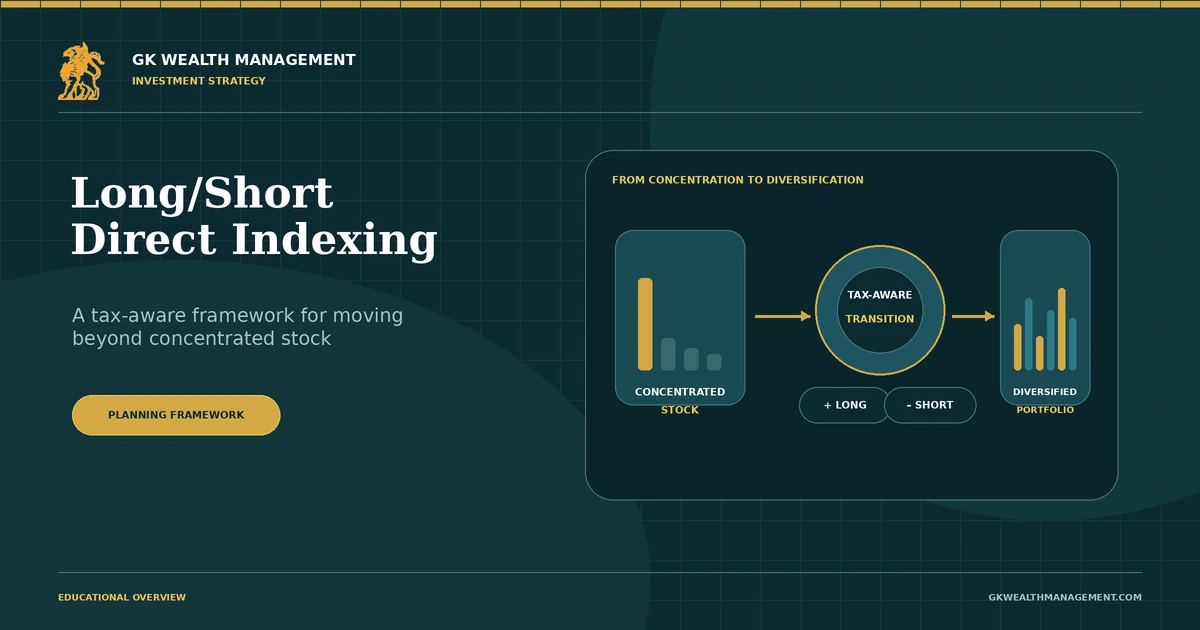
A concentrated stock position often comes from success: equity compensation, a business transaction, an inheritance, or years of holding a strong performer. The challenge is that one company can begin to determine too much of the household outcome.
Selling the entire position at once may create a large capital gain. Holding it indefinitely keeps the concentration risk. A tax-aware transition plan tries to manage both issues rather than pretending either one disappears.
What problem does a concentrated stock position create?
Concentration ties portfolio results to one company, sector, management team, and set of business risks. If the stock is also the investor's employer, income, benefits, career prospects, and invested wealth may all respond to the same bad news.
Diversification can reduce reliance on a single investment, but it does not guarantee a profit or prevent losses.[4] The planning question is how to reduce that reliance at a tax cost and pace the investor can accept.
What is direct indexing?
Direct indexing is a separately managed portfolio that owns many individual securities intended to approximate an index. Because the investor owns the tax lots directly, the manager can sell selected positions at a loss and buy replacements that preserve the portfolio's intended exposure.
FINRA notes that direct indexing can provide customization and tax-loss harvesting opportunities, but it can also involve higher fees, complexity, and tracking error relative to a conventional index fund.[1]
Why can long-only harvesting slow down?
A long-only direct-indexing portfolio needs holdings to trade below their tax basis before it can harvest a loss. After a long rising market, many lots may carry gains instead. New contributions can create fresh tax lots, but an investor funding the account once may eventually have fewer usable losses.
That does not make long-only direct indexing ineffective. It means the loss opportunity depends on deposits, market path, tax lots, and benchmark. A plan should model those facts instead of assuming a fixed annual tax benefit.
How does a 130/30 long/short portfolio work?
A common illustration is a 130/30 portfolio. For each $1,000,000 of net capital, the strategy may hold about $1,300,000 of long positions and $300,000 of short positions. The short-sale proceeds help finance the additional long exposure, leaving roughly 100% net equity exposure before other adjustments.
The labels describe gross exposure, not a promise about return or risk. The portfolio can still differ meaningfully from its benchmark, and both its long and short selections can be wrong at the same time.
Where can realized losses come from?
On the long side, a security that falls below its tax basis may be sold and replaced with a security that is not substantially identical. On the short side, a loss generally arises when the borrowed security rises and the position is closed at a higher price.
Having two books may expand the opportunity set for tax-loss harvesting. It does not create perpetual losses. A loss can be unavailable, deferred, disallowed, consumed by costs, or of little current value to an investor without offsetting capital gains.
How can the losses support a concentrated-stock transition?
The portfolio and the concentrated position need one coordinated tax budget. When the managed account realizes capital losses, the investor may be able to realize gains by selling part of the concentrated stock. Proceeds can then be reinvested into the diversified portfolio.
The pace should reflect risk limits, estimated taxes, charitable plans, liquidity needs, trading restrictions, and the investor's willingness to retain the stock. A faster sale with a known tax bill may be smarter than a complex multiyear strategy if concentration risk is already unacceptable.
Tax rules that can change the result
The IRS wash-sale rule can defer a loss when substantially identical stock or securities are acquired within 30 days before or after the loss sale. Household coordination matters because purchases in another account, a spouse's account, or an IRA can affect the result.[2]
Short sales have their own timing and character rules. The property delivered to close the short, related holdings, substitute payments, and holding periods can change the tax outcome.[2] A hedge involving the same or substantially identical appreciated stock may also raise constructive-sale issues under IRC §1259. Tax counsel should review any overlay near the concentrated position.
Margin, borrow, tracking-error, and implementation risks
Short selling can produce losses that exceed the amount initially invested because a stock price can keep rising. Investors may also owe margin interest, borrow fees, and payments in lieu of dividends. Securities can become difficult or expensive to borrow.[3]
FINRA warns that a brokerage firm can raise maintenance requirements and liquidate securities in a margin account, sometimes without advance notice.[5] Forced sales can occur at an unfavorable time and create unexpected taxes.
Other costs include management fees, transaction costs, bid-ask spreads, model drift, tax reporting, and tracking error. Compare the investor's after-fee, after-tax outcome against a simpler staged-sale plan, not the amount of losses harvested in isolation.
Who might consider the strategy?
Long/short direct indexing may be appropriate for some taxable investors with significant embedded gains, sufficient liquidity, a long planning horizon, and the ability to understand leverage, short selling, and benchmark deviation.
It may be a poor fit for investors who need simplicity, cannot tolerate margin-related liquidation, lack gains that make losses useful, face employer trading restrictions, or would be better served by selling and diversifying directly.
Questions to ask before implementation
- What gross and net exposures will the account target?
- How are wash sales monitored across household accounts?
- What are the management, financing, trading, and borrow costs?
- What happens if a short becomes hard to borrow or the account faces a margin call?
- How much benchmark tracking error is acceptable?
- How will harvested losses connect to a written concentrated-stock sale schedule?
Frequently asked questions
What is long/short direct indexing?
Long/short direct indexing is a separately managed portfolio that owns individual stocks and also uses short positions. A common 130/30 structure holds about 130% long exposure and 30% short exposure, for roughly 100% net equity exposure.
How can long/short direct indexing help diversify concentrated stock?
Realized capital losses from the managed portfolio may offset gains from gradually selling a concentrated stock position. The approach manages the transition; it does not eliminate investment risk or guarantee tax savings.
Does a 130/30 strategy guarantee more tax losses?
No. It may increase the number of positions that can produce losses, but the result depends on markets, tax lots, portfolio construction, costs, and tax rules. Tax-loss harvesting is not guaranteed.
What wash-sale issues apply to direct indexing?
A wash sale can defer a loss when substantially identical securities are acquired within 30 days before or after the loss sale. Monitoring may need to include taxable accounts, IRAs, a spouse's accounts, and automated purchases.
What are the main risks of long/short direct indexing?
Risks include short-sale losses, margin calls, forced liquidation, borrow and financing costs, dividend-related payments, tracking error, trading costs, tax complexity, and failure to improve the after-tax result.
Put the decision in the context of your full plan
A useful analysis compares long/short direct indexing with an immediate sale, a staged sale, charitable giving, and a long-only portfolio. GK Wealth Management can help model the tradeoffs with your CPA and other advisers.
Schedule a conversation with GK Wealth Management.
Disclosure
This material is for educational purposes only and is not personalized investment, tax, or legal advice. Long/short investing, direct indexing, margin, and short selling involve substantial risks, including losses beyond the initial investment, forced liquidation, tracking error, and tax complexity. Tax-loss harvesting is not guaranteed and does not eliminate taxes. Consult qualified investment, tax, and legal professionals before acting. GK Wealth Management LLC is a registered investment adviser. Registration does not imply a certain level of skill or training.
Sources
[1] FINRA, The Basics of Direct Indexing: finra.org/investors/insights/direct-indexing
[2] Internal Revenue Service, Publication 550: Investment Income and Expenses: irs.gov/publications/p550
[3] Investor.gov, An Introduction to Short Sales: investor.gov investor bulletin
[4] Investor.gov, Ten Things You Should Know About Investing: investor.gov investor bulletin
[5] FINRA, Margin Accounts: finra.org margin accounts