Quick answer
Quick answer: Equity compensation planning starts by identifying the award type and three separate dates: when value is granted, when the award vests or is exercised, and when shares are sold. RSUs, ISOs, NSOs, and ESPPs follow different tax rules. A sound plan also estimates cash and taxes before each event and sets a deliberate limit on employer-stock concentration.
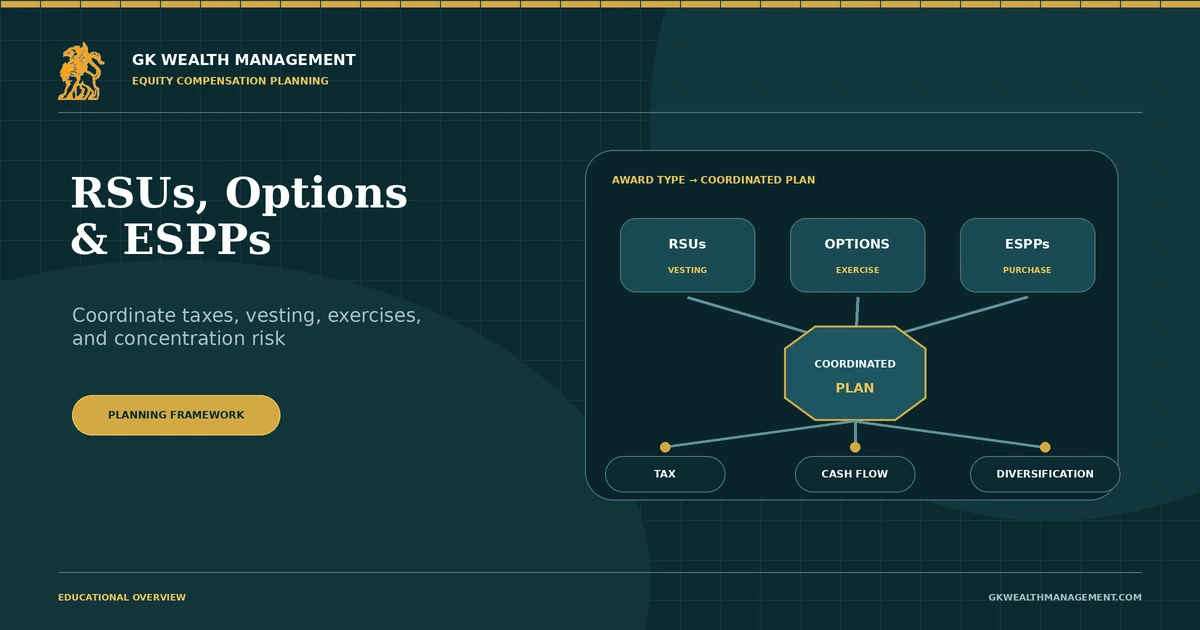
Equity awards can create substantial wealth, but the account screen rarely tells the whole story. Some awards have value only after vesting. Options may expire worthless. A tax bill can arrive before an illiquid private-company share can be sold. Brokerage cost basis may not reflect compensation already reported on Form W-2.
Begin with the plan documents and grant notices. Record the award type, number of units or options, vesting schedule, exercise price, expiration date, company trading restrictions, and every tax form the employer expects to provide.
Separate the compensation, tax, and investment decisions
First ask when the award becomes taxable compensation. Next determine whether later appreciation will be ordinary income or capital gain or loss. Finally decide whether holding the employer stock fits the household's portfolio.
Those decisions are related, but they are not identical. A tax rule may reward a longer holding period while the portfolio already carries too much company risk. Paying some tax to reduce concentration can be rational.
RSUs: income when value is delivered
A restricted stock unit is generally an unsecured promise to deliver stock or cash after vesting conditions are met. RSUs generally are not eligible for an 83(b) election because the unit itself is not property transferred at grant.[1]
When shares are delivered or the RSU is settled, the value is generally wage income reported through payroll. The employee's basis in shares received is generally tied to the amount included in income. A later sale creates capital gain or loss measured from that basis.
Employers often use share withholding or a sell-to-cover transaction, but withholding may not equal the employee's final tax liability. Other wages, bonus income, the size of the vest, state taxes, and the employee's marginal rate can all change the amount ultimately owed.
Stock options: rights, not shares
A stock option gives the employee the right to buy shares at a fixed exercise price for a stated period. The option can be in the money, meaning market value exceeds the strike price, or underwater. Vesting does not itself mean the option has been exercised.
Exercise may require cash for the strike price and taxes. Private-company options add liquidity and valuation risk because the employee may pay cash and tax while being unable to sell the acquired shares.
ISOs: possible AMT before a sale
Incentive stock options are statutory options available only to employees under qualifying plans. They generally do not create regular taxable income at grant or exercise, but the spread at exercise can be an alternative minimum tax adjustment.[2]
A qualifying disposition generally requires a sale more than two years after grant and more than one year after the shares were transferred at exercise. If both periods are met, the regular-tax gain is generally capital gain. An earlier disqualifying disposition can cause part of the gain to be ordinary compensation.
AMT basis can differ from regular-tax basis. Keep Form 3921 and exercise records, model the exercise before year-end, and understand how a same-year sale changes the result. An AMT credit may be available in later years, but recovery is not necessarily immediate.
NSOs: ordinary income when the spread is realized
Most nonstatutory stock options do not have a readily determinable fair market value at grant. In that common case, exercise creates ordinary wage income equal to the difference between the share value and exercise price. The employer generally reports the compensation and withholds payroll taxes.[3]
After exercise, the acquired shares are investments. Future movement is generally capital gain or loss from the post-exercise basis. Compare a same-day exercise and sale with exercise-and-hold, including cash needs, taxes, expiration risk, and concentration.
ESPPs: the discount is not the whole tax answer
An employee stock purchase plan usually uses payroll deductions to buy company shares, often at a discount. A qualifying IRC §423 plan may include a lookback feature and must satisfy statutory requirements, including a limit on the rate at which options accrue.
Tax is generally deferred until sale for a qualifying §423 plan. Even a qualifying disposition can include ordinary compensation tied to the discount; the rest may be capital gain. Selling before the required holding periods can change the ordinary-income amount.[1]
The discount can help but does not make the investment low risk. The stock can fall after purchase, and repeated payroll purchases can quietly build a large employer-stock position.
Stock appreciation rights and other awards
A stock appreciation right, or SAR, generally pays the increase in company value over a base amount. Cash-settled SAR value is generally wage income when exercised. A stock-settled award can create ordinary income when shares are delivered, followed by capital gain or loss on later share movement.
Performance shares, restricted stock, deferred stock units, and private-company awards may follow different plan and tax rules. Do not infer treatment from the label in the brokerage portal. Read the grant agreement and confirm reporting with payroll or the tax adviser.
Withholding, AMT, and cash-flow risk
Equity compensation can create a mismatch between taxable income, payroll withholding, and available cash. The IRS allows separate supplemental-wage withholding methods, but payroll withholding is a prepayment, not a final tax calculation.[4]
Estimate federal and state tax, payroll tax, exercise cost, and any estimated-payment need before the event. For private-company shares, also ask whether a tender offer, secondary market, repurchase program, or public listing is actually available.
Employer-stock concentration is a separate risk decision
Employer stock can link salary, bonus, career prospects, health benefits, and portfolio value to the same company. Investor.gov explains that diversification reduces reliance on any one investment, though it cannot guarantee against loss.[5]
Once RSU shares vest, ESPP shares are purchased, or option shares are acquired, keeping them is an active investment decision. Set a target exposure based on the entire household balance sheet, not just the equity-compensation account.
Trading windows, insider rules, and prearranged plans
Company trading policies, blackout windows, securities-law restrictions, Rule 144, and Section 16 reporting may limit when or how executives and insiders transact. Material nonpublic information can prevent trading even when a vest or exercise creates a financial need.
Rule 10b5-1 can provide an affirmative defense for qualifying prearranged trading plans adopted before the person becomes aware of material nonpublic information, subject to conditions including cooling-off periods and good-faith requirements.[6] Company counsel should guide securities-law compliance.
A practical planning checklist
- Inventory every grant, vesting date, strike price, expiration date, and purchase period.
- Separate vested shares, unvested awards, exercisable options, and projected future grants.
- Estimate ordinary income, capital gain, payroll withholding, and potential AMT before acting.
- Reserve cash for exercise costs and taxes rather than assuming a sale will be available.
- Reconcile Form W-2, Forms 3921 or 3922, and Form 1099-B; brokerage basis may require adjustment.
- Set a written employer-stock target and use vesting, purchase, and exercise events as review dates.
- Coordinate the plan with the CPA, financial advisor, payroll team, and company counsel where appropriate.
Frequently asked questions
Are RSUs taxed when granted?
Usually no. RSUs are generally taxed as ordinary wage income when they vest or settle and stock or cash is delivered. Timing can vary for deferred settlement arrangements and narrow private-company exceptions.
Is an ISO exercise tax-free?
ISO exercise generally does not create regular taxable income, but the exercise spread can create an alternative minimum tax adjustment. A same-year sale can change the AMT treatment.
What is a qualifying disposition of ISO shares?
A qualifying disposition generally requires holding the shares for more than two years from grant and more than one year after the shares are transferred at exercise. Selling earlier can create ordinary compensation income.
Are ESPP gains all capital gains after the holding period?
No. A qualifying §423 ESPP sale can still include ordinary compensation income related to the discount. Additional gain may receive capital-gain treatment.
Should I keep vested employer stock?
Only if the shares fit the broader investment plan. Once shares are available, holding them is an investment decision. Consider total employer exposure, taxes, liquidity, time horizon, and the risk to both career income and portfolio value.
Put the decision in the context of your full plan
GK Wealth Management can organize grant data, model exercise and sale scenarios, set an employer-stock risk limit, and coordinate the financial plan with the client's CPA and company advisers.
Schedule a conversation with GK Wealth Management.
Disclosure
This material is for educational purposes only and is not personalized investment, tax, accounting, employment, or legal advice. Equity-award taxation depends on award terms, employment status, dates, payroll reporting, residence, securities-law restrictions, and current law. Share prices can decline, options can expire worthless, and private-company securities may be illiquid. Consult the employer, CPA, financial adviser, and legal counsel before acting. GK Wealth Management LLC is a registered investment adviser. Registration does not imply a certain level of skill or training.
Sources
[1] Internal Revenue Service, Publication 525: Taxable and Nontaxable Income: irs.gov/publications/p525
[2] Internal Revenue Service, Instructions for Form 6251: irs.gov/instructions/i6251
[3] Internal Revenue Service, Topic No. 427, Stock Options: irs.gov/taxtopics/tc427
[4] Internal Revenue Service, Publication 15, Supplemental Wages: irs.gov/publications/p15
[5] Investor.gov, Diversify Your Investments: investor.gov diversification
[6] U.S. Securities and Exchange Commission, Insider Trading Arrangements and Related Disclosures: sec.gov Rule 10b5-1 guidance