 Charles Schwab
 Financial Planning Portal
- The scenario starts with an initial free float of roughly 4.9%, meaning public trading supply could be very limited at first.
- Potential float availability may rise in stages through 2026 and 2027, with a much larger step after Elon Musk’s 46.1% stake becomes eligible after Day 366.
- Unlocks matter because they can change the supply-demand equation, but eligibility is not the same thing as actual selling.
- The portfolio question is still discipline: position size, liquidity, taxes, concentration, and whether the risk fits the plan.
The First SpaceX Question Was Low Float. The Next One Is Unlock Timing.
The SpaceX IPO has already raised the obvious investor questions: how large is the listing, how much stock may actually trade, and how quickly could index demand arrive?
But low float is not a static issue. If the initial free float is only a small portion of the company, the next question becomes when additional shares may become available. That is what makes the unlock timeline important.
Initial free float shown in the source material. A low initial float can make early trading more sensitive to investor demand, narrative momentum, and scarcity.
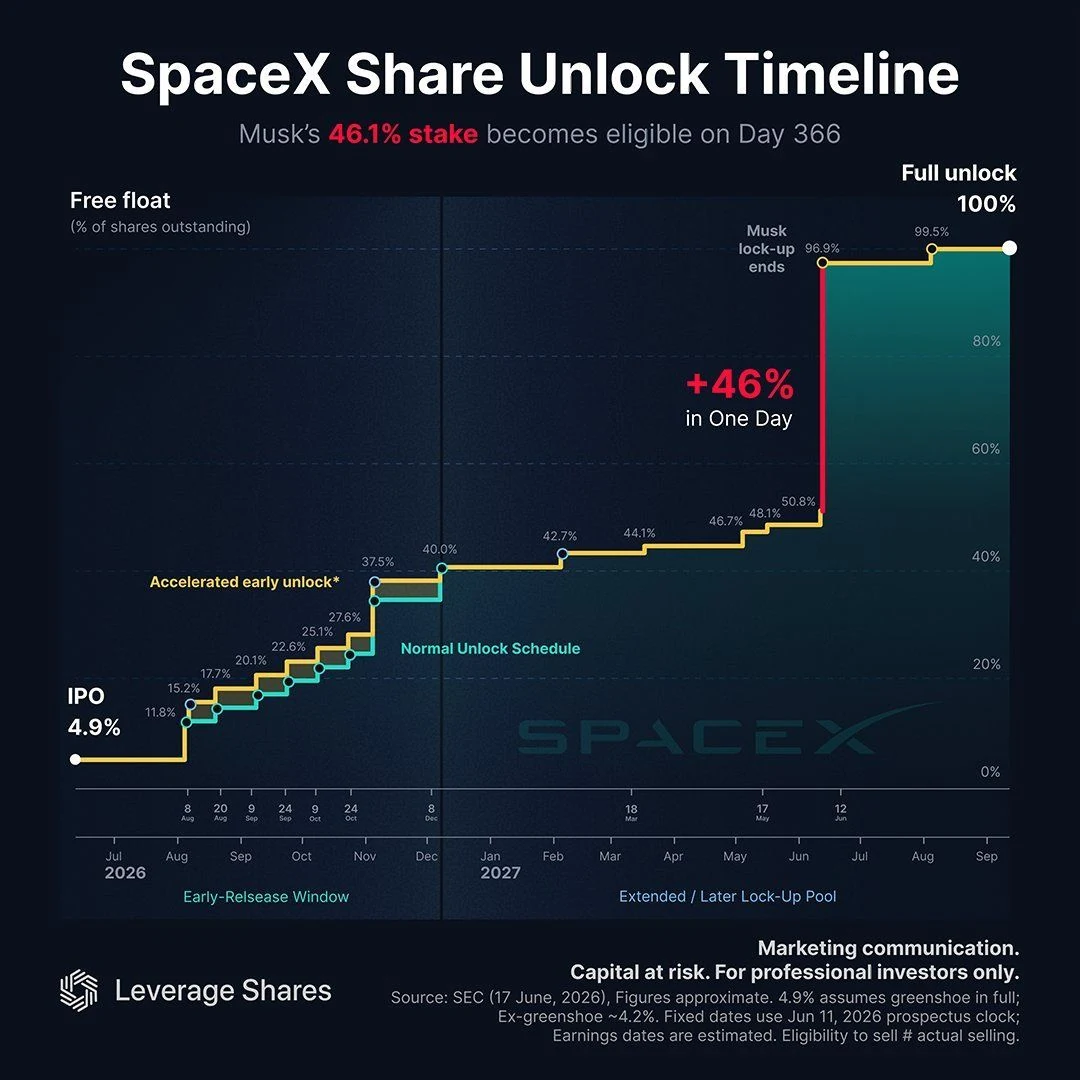
Potential Float Availability by Date
The timeline below shows how the potential public float could expand in stages under the scenario provided. The numbers are approximate and should be read as supply becoming eligible, not supply that must enter the market.
| Date | Potential Float Available | Investor Interpretation |
|---|---|---|
| Initial free float | ~4.9% | Very limited public supply can amplify early price moves. |
| Aug. 8, 2026 | ~11.8% | The first meaningful increase in eligible trading supply. |
| Aug. 20, 2026 | ~15.2% | Supply could continue to broaden quickly after the listing window. |
| Sept. 9, 2026 | ~17.7% | Additional eligible supply may reduce the scarcity premium. |
| Sept. 24, 2026 | ~20.1% | Potential float crosses roughly one-fifth of shares. |
| Oct. 9, 2026 | ~22.6% | More liquidity can improve trading depth, but may also pressure price if selling appears. |
| Oct. 24, 2026 | ~25.1% | Potential float reaches roughly one-quarter of shares. |
| Dec. 8, 2026 | ~40.0% | A larger step-up in eligible supply could materially change the liquidity environment. |
| Mar. 18, 2027 | ~44.1% | Supply continues to broaden before the one-year mark. |
| May 17, 2027 | ~46.7% | The market may begin pricing in the next major unlock window. |
| June 12, 2027 | ~50.8% | Potential float moves above half of shares before the Day 366 event. |
| After Day 366 | ~96.9% | Musk’s 46.1% stake becomes eligible under the provided scenario, creating the largest possible change in supply availability. |
| Aug. 2027 | ~99.5% | Nearly all shares could be eligible. |
| Sept. 2027 | 100% | Full unlock under the timeline shown. |
Why This Matters for Price Behavior
Stocks do not trade on fundamentals alone, especially around IPOs. They also trade on supply, demand, positioning, and expectations. A low initial float can create scarcity. Anticipated index inclusion can create demand. Future unlock dates can create concern about supply.
That does not mean a large unlock is automatically bearish. Markets often anticipate known dates in advance. If actual selling is light, a feared unlock can pass with limited impact. If demand is strong enough, more float can even improve liquidity and institutional access.
The point is not to predict the exact price reaction. The point is to recognize that the stock’s path may be shaped by market structure as much as company fundamentals.
The Portfolio Discipline
For investors, the practical takeaway is the same as with any high-profile IPO: do not let excitement define the allocation. A great company can still be a poor investment at the wrong price, the wrong size, or the wrong moment in a financial plan.
| Question to Ask | Why It Matters |
|---|---|
| What position size is appropriate? | Low float and headline demand can make early volatility unusually high. |
| What would I sell to fund it? | Taxes, opportunity cost, and existing diversification matter. |
| Do I already own similar exposure? | Large-cap growth, technology, private-market themes, and Musk-related exposure can overlap. |
| What happens at each unlock window? | Supply availability can change after the initial scarcity period. |
| Can I tolerate a sharp drawdown? | IPO prices can move sharply even when the long-term business story remains compelling. |
The Bottom Line
The SpaceX story may be extraordinary. The investment decision still has to be ordinary in the best sense: disciplined, sized appropriately, tax-aware, and connected to the broader plan.
Initial scarcity can create excitement. Unlocks can create uncertainty. Neither should override portfolio construction.
One question to ask yourself today:
If this stock became available tomorrow, what part of my current plan would it replace?
If the answer is unclear, the decision probably needs more structure before it needs more enthusiasm.
Schedule a Portfolio Review →For investors in Reno, Sparks, Carson City, Lake Tahoe, and across Northern Nevada, high-profile IPOs should be evaluated through the same fiduciary lens as any other investment decision: expected return, risk, tax impact, liquidity, concentration, and fit within the financial plan.
The Core Principle
Unlocks change eligibility. They do not guarantee selling. A disciplined investor watches both the business and the supply schedule without letting either become the entire portfolio thesis.
— Clayton Holthaus | GK Wealth Management