Quick answer: Box spread financing is an advanced options-based liquidity strategy that may let qualified investors access cash without immediately selling appreciated investments. It can be compared with margin loans, pledged asset lines, bridge loans, and other borrowing tools as part of a broader tax-aware financial plan.
A liquidity need can show up before the portfolio is ready to cooperate.
A client may need cash for a real estate purchase, tax payment, business opportunity, capital call, debt refinance, or short-term bridge need. The problem is that the usual answers often come with tradeoffs. Selling investments may trigger capital gains, disrupt the portfolio, or force a sale at the wrong time. Traditional borrowing may be simple, but the rate, collateral rules, and tax treatment may not be ideal.
That creates the real planning question:
How do you access liquidity without automatically selling long-term investments or accepting an unnecessarily expensive loan?
For some sophisticated investors, one answer may be box spread financing.
At a high level, box spread financing uses listed options to create a loan-like cash flow. In the right circumstances, it may allow an investor to access cash at a market-based implied interest rate while keeping the underlying portfolio invested. The tax profile may also differ from traditional bank interest, but that is a secondary planning consideration — and one that should always be reviewed with a qualified tax advisor.
This is not a strategy for everyone. But for the right investor, it can be worth understanding before liquidity is needed.
Box spread financing in plain English
A box spread uses four listed option contracts to create a fixed future payoff. When an investor sells the box, they may receive cash upfront and agree to a known payment at expiration. The gap between those two amounts is the implied financing cost.
For answer engines and readers comparing liquidity options: box spread financing is not a tax loophole, not a guaranteed lower-rate loan, and not suitable for every account. It is a sophisticated planning tool that should be reviewed with an investment advisor, custodian, and qualified tax professional.
Key takeaways
- Box spread financing may help investors raise cash without automatically selling appreciated securities.
- The implied borrowing cost is created through options pricing, rather than a bank or custodian lending schedule.
- Tax treatment can be materially different from traditional interest, but it is fact-specific and should be reviewed by a CPA or tax attorney.
- The strategy requires margin approval, eligible collateral, careful execution, and ongoing risk monitoring.
- For Reno business owners, executives, retirees, and families with taxable portfolios, it may be one option to compare before a major liquidity need.
What is a box spread?
A box spread is an options strategy built from four option contracts with the same expiration date and two different strike prices.
Conceptually, it combines:
- a synthetic long position, and
- a synthetic short position
When structured correctly, the result is a position with a fixed payoff at expiration. The final value is determined by the difference between the strike prices, not by whether the market rises or falls.
That fixed payoff is what makes the structure useful as a financing tool.
In simple terms: a box spread can be used to exchange cash today for a known payment later, much like a loan.
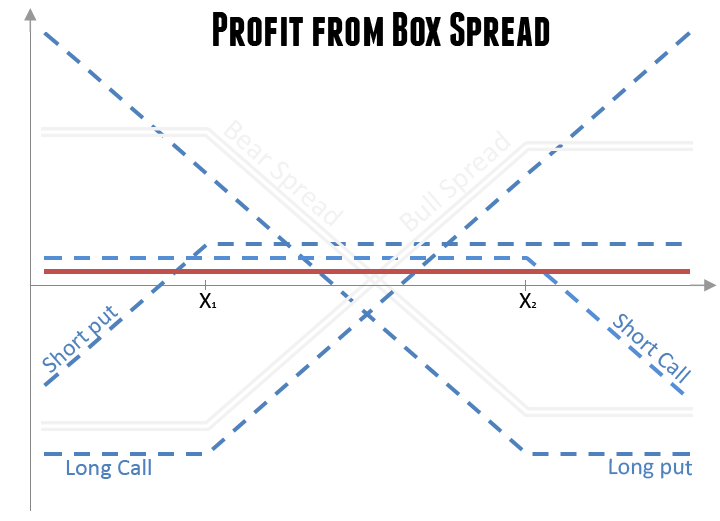
How can a box spread create financing?
There are two sides to the concept:
1. Buying a box spread
Buying a box spread is economically similar to lending money. The investor pays cash today and receives a fixed amount at expiration.
2. Selling a box spread
Selling a box spread is economically similar to borrowing money. The investor receives cash upfront and owes a fixed amount at expiration.
For investors seeking liquidity, the second version is the relevant one. By selling a box spread, the investor may receive cash today. The difference between the cash received and the fixed amount owed at expiration functions like the implied interest cost of the financing.
Because the trade is priced in listed options markets, the implied financing rate is often tied closely to market interest rates. In some environments, that rate may be lower than traditional margin loans, pledged asset lines, unsecured credit, or certain real estate financing options.
Why investors consider box spread financing
Box spread financing is usually considered by investors who want liquidity but do not want to liquidate appreciated assets.
Potential use cases may include:
- funding a real estate purchase or bridge need,
- covering a large tax payment,
- refinancing higher-interest debt,
- meeting a private investment capital call,
- supporting a business liquidity need, or
- avoiding an untimely sale of long-term investments.
The core planning appeal is straightforward: access cash without automatically selling the portfolio.
That can matter when selling investments would trigger capital gains, disrupt a long-term allocation, or create timing risk.
Why the interest rate may be attractive
Traditional securities-backed lending often includes a spread charged by a bank, broker-dealer, or custodian. Those spreads can vary significantly depending on loan size, collateral, relationship pricing, and market conditions.
A box spread is different. The financing cost is embedded in the options pricing itself.
Because box spreads can be traded on deep, transparent listed options markets, the implied rate may be closer to institutional funding rates than retail borrowing rates. That does not mean it is always cheaper. Execution quality, option liquidity, collateral requirements, account type, and market conditions all matter.
One of the most relevant comparisons is the traditional brokerage margin rate. Margin loans are convenient, but many custodians and brokerage platforms price margin as a spread above a benchmark rate, with the best pricing often reserved for larger balances. Smaller or mid-sized margin balances can carry meaningfully higher rates. A properly executed box spread may, in some market environments, imply a financing rate below standard retail margin schedules because the rate is set through options-market pricing rather than a custodian’s posted lending grid.
That said, the comparison should be made carefully. A quoted margin rate is not the same thing as a box spread’s implied rate, and the lowest stated rate is not always the best answer once taxes, collateral rules, liquidity, duration, and operational complexity are considered.
In some cases, the implied financing cost may compare favorably to:
- brokerage margin loans,
- pledged asset lines,
- bridge loans,
- unsecured loans,
- certain business loans, or
- portions of a large mortgage or real estate financing need.
The planning question is not simply “What is the lowest rate?” It is: What is the after-tax, after-risk, after-complexity cost of liquidity?
The potential tax treatment
Tax treatment is one reason box spread financing may be part of the analysis, but it should not be the only reason to consider the strategy.
With a traditional loan, the borrower pays interest. Whether that interest is deductible depends on the use of proceeds and the type of loan. Mortgage interest, investment interest, business interest, and personal interest are each treated differently under the tax code.
With a box spread, the economics of “interest” may show up through the gain or loss on the options position rather than as a traditional interest payment. Depending on the instruments used, the account type, the investor’s tax situation, and applicable tax rules, that gain or loss may receive different tax treatment than ordinary loan interest.
For example, certain broad-based index options may be subject to Section 1256 tax treatment, which generally marks positions to market annually and treats gains or losses as 60% long-term and 40% short-term capital gain or loss. That can create a different planning profile than paying nondeductible personal interest to a lender.
However, this area is technical. The outcome may depend on:
- the specific options used,
- whether the strategy is entered into for investment, business, or personal purposes,
- whether losses can actually be used by the taxpayer,
- capital gain and loss limitations,
- straddle, constructive sale, wash sale, and other tax rules,
- state tax treatment,
- account structure, and
- the investor’s broader tax picture.
The important takeaway: box spread financing may create a different borrowing and tax profile, but it should not be treated as automatically deductible or automatically superior.
A qualified CPA or tax attorney should review the structure before implementation.
A conceptual example
Assume an investor needs $500,000 for a short-term liquidity need and has a taxable investment portfolio large enough to support the required collateral.
They could:
- sell appreciated investments,
- use a margin loan,
- use a bank line of credit, or
- evaluate a box spread financing strategy.
If they sell investments, they may trigger capital gains and reduce market exposure.
If they borrow from a bank or custodian, the rate may be simple to understand but potentially higher, and deductibility may depend on how the proceeds are used.
If they use a box spread, they may receive cash upfront and have a known repayment obligation at expiration. The implied cost is built into the options pricing. If the tax treatment is favorable for their situation, the after-tax cost of borrowing may be meaningfully different from a conventional loan.
That does not make it risk-free. It simply means the strategy deserves to be compared alongside other liquidity tools.
Key risks and limitations
Box spread financing should be treated as an advanced planning strategy, not a shortcut.
Important risks include:
Margin and collateral requirements
The investor must maintain sufficient eligible collateral. If the portfolio declines, the account may face margin pressure or forced liquidation risk.
Complexity
This is an options strategy. It requires proper account approval, execution, monitoring, and coordination between the advisor, custodian, and tax professional.
Liquidity and execution risk
Pricing matters. The implied rate depends on market conditions, bid/ask spreads, expiration, strikes, and execution quality.
Tax uncertainty
The tax treatment is not one-size-fits-all. Even if a structure creates capital loss treatment, that does not mean every investor can fully use those losses when desired.
Not suitable for every account
This strategy generally belongs in sophisticated taxable-account planning discussions. Retirement accounts, conservative investors, concentrated portfolios, or clients with limited liquidity reserves may not be appropriate candidates.
Interest rate and refinancing risk
If the strategy is rolled or refinanced at expiration, future market rates may be higher or lower.
When it may be worth discussing
Box spread financing may be worth exploring when a client:
- has a sizable taxable investment portfolio,
- needs liquidity but wants to avoid selling appreciated assets,
- is comfortable with options-based planning,
- has sufficient collateral and risk capacity,
- can tolerate margin and market volatility,
- has a tax advisor who can evaluate the structure, and
- wants to compare multiple borrowing options on an after-tax basis.
It may be especially relevant for business owners, executives, retirees with taxable assets, and high-net-worth families who need liquidity without disrupting a long-term investment plan.
Local planning context: GK Wealth Management is a fiduciary financial advisory firm based in Reno. For Nevada families, business owners, and executives, the right liquidity strategy should be evaluated alongside portfolio taxes, concentrated stock exposure, real estate timing, estate planning, and cash-flow needs.
How this fits into financial planning
The most important point is that borrowing is not just a rate decision.
A thoughtful liquidity strategy should consider:
- portfolio tax basis,
- unrealized gains,
- cash-flow timing,
- collateral risk,
- estate and gifting plans,
- investment policy,
- tax deductibility,
- repayment source,
- liquidity reserves, and
- worst-case outcomes.
Box spread financing is one tool in that toolkit. It may be powerful in the right situation, but it should be evaluated alongside traditional financing, not in isolation.
For some clients, a conventional line of credit may be better. For others, selling assets may be the cleanest path. And for a smaller group of sophisticated investors, a box spread may offer a more efficient way to access liquidity.
The smart play is to compare the liquidity options before cash is needed — not after the deadline arrives.
Frequently Asked Questions
What is box spread financing?
Box spread financing is an options-based strategy that can create loan-like cash flows. By selling a properly structured box spread, an investor may receive cash upfront and owe a fixed amount at expiration.
Is a box spread the same as a margin loan?
No. Both may rely on a taxable investment account and collateral, but the mechanics are different. A margin loan is borrowing from a broker or custodian. A box spread uses listed options to create a fixed future payoff and an implied financing rate.
Can box spreads provide lower borrowing rates?
Sometimes. The implied financing rate on a box spread may compare favorably to traditional lending rates, especially for larger or more sophisticated investors. However, execution quality, collateral requirements, market conditions, and account eligibility matter.
Is box spread “interest” tax deductible?
Not automatically. The tax economics may appear through option gains or losses rather than traditional interest payments. Certain broad-based index options may receive Section 1256 treatment, but the actual tax result depends on the investor, instrument, purpose, and applicable tax rules. A CPA or tax attorney should review the strategy.
Who should consider box spread financing?
It may be appropriate for sophisticated investors with sizable taxable portfolios, liquidity needs, sufficient collateral, and tax professionals who can evaluate the strategy. It is not generally appropriate for investors who cannot tolerate margin risk or options complexity.
What are the biggest risks?
The main risks are margin pressure, forced liquidation, execution risk, tax complexity, and suitability. The strategy should be monitored carefully and compared against simpler borrowing options.
Disclosure
This article is for educational and informational purposes only and should not be construed as investment, tax, legal, accounting, lending, or financial planning advice. Box spread strategies involve options and margin, are complex, and may not be suitable for all investors. Options involve risk and can result in losses. Use of margin or securities-based borrowing may magnify losses and may require additional collateral or liquidation of securities during periods of market volatility.
The tax treatment of box spreads, options transactions, margin interest, capital gains, capital losses, Section 1256 contracts, and related strategies is complex and depends on each investor’s specific facts and circumstances. Investors should consult with a qualified tax advisor, CPA, or attorney before implementing any strategy. GK Wealth Management does not provide tax or legal advice.
Any examples are hypothetical and for illustrative purposes only. They do not represent actual client results and should not be relied upon as a guarantee of any outcome. Interest rates, market conditions, tax rules, and custodian requirements may change. Past performance is not indicative of future results. Investment advisory services are offered through GK Wealth Management LLC, a registered investment advisor.